
AI Is Already Changing How M&A Deals Get Sourced and Screened

AI now measurably speeds up sourcing, diligence, and integration for M&A teams, and the professionals capturing the gains are the ones pairing automation with disciplined human review. Deal teams using generative AI report significant cost reductions and notably faster cycle times. The catch: most organizations still haven't fully integrated it into their workflow, and skipping human oversight is where deals go wrong.
TL;DR:
- Fully integrated AI systems can reduce deal cycle times by 30 to 50 percent and cut costs by around 20 percent, but most firms still operate with pilot or bolt-on solutions.
- Effective AI sourcing tools can identify hundreds of targets in under a day, but require well-defined filters, clean thesis statements, and manual verification of signals.
- AI can automate contract and financial data review, yet human judgment remains essential for assessing materiality, interpreting clauses, and evaluating outside context.
- Using AI in post-signature integration accelerates planning and execution, but success depends on phased rollout, pilot testing, and establishing clear governance protocols.
- The biggest risks include hallucinated outputs, biased training data, and data leaks, making human oversight and strict controls crucial before trusting AI-generated deal work.
Table of Contents
- What Is the Current State of AI Adoption in M&A?
- How Does AI Improve Sourcing and Pipeline Screening?
- Can AI Actually Handle Due Diligence Document Review?
- How Does AI Support Integration After Signing?
- What Are the Biggest Risks of Using AI in M&A?
- What Does a Realistic AI Rollout Look Like for a Deal Team?
- What Measurable Results Are Firms Seeing From AI-Enabled Diligence?
- What Should Deal Teams Prioritize First When Adopting AI?
- Where Does Add-back Fit Into Your AI Adoption Plan?
- Sources
What Is the Current State of AI Adoption in M&A?
Adoption has crossed a threshold that would have seemed unlikely three years ago. As of 2026, 90% of M&A organizations report using generative AI somewhere in their deal process, according to Deloitte's pulse study. Only a minority have achieved full integration across the entire deal life cycle. Most teams are still running AI as a bolt-on tool for specific tasks rather than a connected system.
The gap between "using AI" and "integrated AI" is where the real advantage sits right now. Teams that push past pilot mode into embedded workflows see the sharpest returns: McKinsey's research found gen AI users averaging around 20% cost reductions, with many reporting deal cycles 30 to 50% faster than their pre-AI baseline.
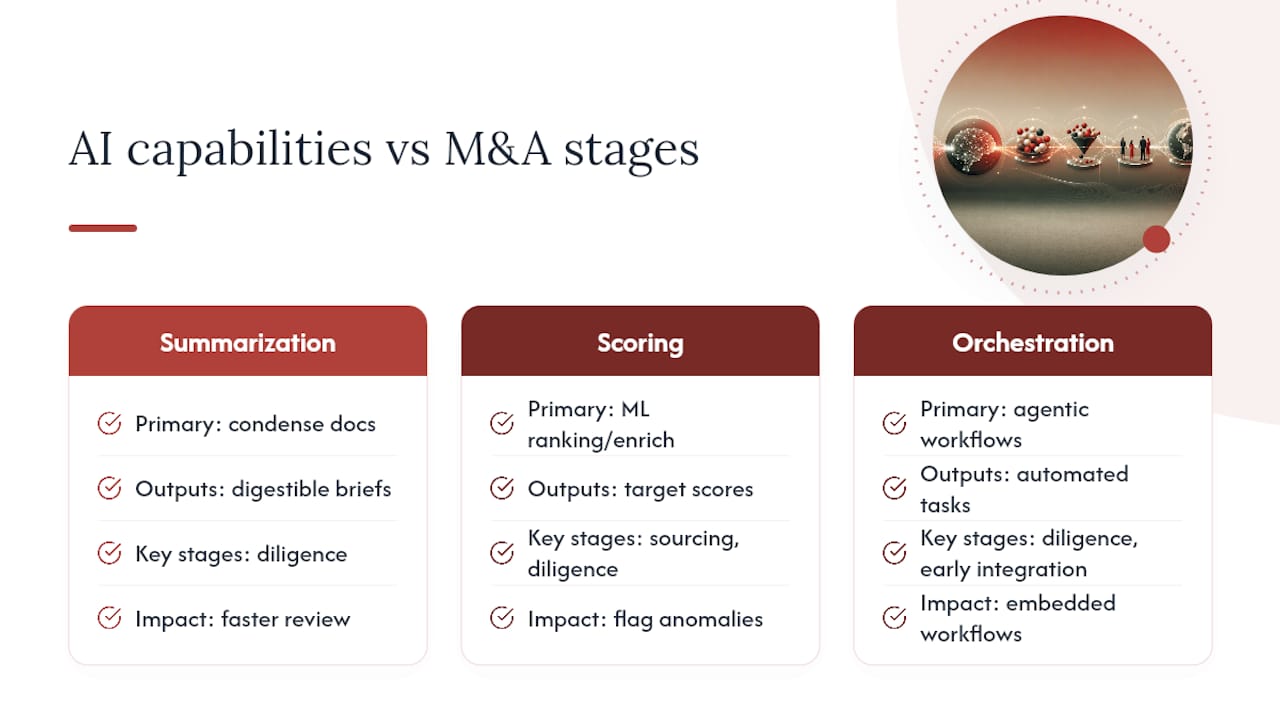
Three capability classes matter most for M&A specifically. Generative summarization condenses contracts, board decks, and data room documents into digestible briefs. Machine learning scoring and enrichment ranks targets and flags financial anomalies against a defined thesis. Agentic workflow orchestration, still emerging, links these outputs together so a diligence finding automatically feeds an integration task list. Right now, the biggest value concentrates in three lifecycle stages: sourcing, diligence, and early integration.
How Does AI Improve Sourcing and Pipeline Screening?
Target identification used to mean a junior analyst manually scanning databases and industry news for weeks. AI-enabled sourcing tools now run continuous scans against structured criteria and surface candidates as signals appear, rather than waiting for a quarterly pipeline review.

The mechanics matter here. A well-built sourcing model ingests public filings, executive job changes, patent filings, hiring patterns, and CRM history, then scores each company against thesis-specific filters like revenue growth trajectory, customer concentration, or geographic footprint. Some signals you can trust directly, like filed financial statements. Others, like a scraped job posting suggesting expansion plans, need a human check before they shape a screening decision.
Done well, this compresses weeks of manual sourcing into hours. Some firms report identifying hundreds of qualified targets in under a day using enrichment models, compared to the much smaller number a traditional analyst team might surface in the same window. That volume only helps if the scoring criteria are tight enough to avoid drowning the deal team in noise.
Before piloting a sourcing tool, prepare these inputs:
- A clean thesis statement translated into quantifiable filters (revenue range, margin profile, customer mix)
- Access to structured data sources: filings, CRM records, industry databases
- A defined false-positive tolerance, since aggressive filters miss real targets and loose filters flood the pipeline
- A review cadence for who checks flagged signals before they reach IC
Pro Tip: Run your AI sourcing model against a pipeline of deals you already closed or passed on. If it had surfaced your last three good acquisitions, the scoring logic is calibrated. If it misses them, fix the filters before trusting it on new deals.
The operational risk isn't that AI misses targets. It's that teams stop verifying the signals once the tool starts producing plausible-looking lists, and a plausible list is not the same as a vetted one.
Can AI Actually Handle Due Diligence Document Review?
Yes, for the parts that involve pattern recognition across volume. No, for the parts that require judgment about materiality or intent. Virtual data room ingestion tools now read thousands of contracts, extract key clauses (change-of-control provisions, termination rights, indemnification caps), and map them into a searchable structure in hours instead of the weeks a legal team would spend on first-pass review.
On the financial side, this is where automation earns its keep fastest. Tools that ingest bank statements, general ledgers, and payroll records can normalize inconsistent formats, flag anomalies in cash flow, and run working capital and revenue-quality checks that used to require a small army of associates working late nights ahead of a management presentation.
What still requires a human, every time:
- Materiality judgment. AI can flag a revenue spike; a person decides if it's a one-time contract or a real trend.
- Legal interpretation. Clause extraction is reliable; interpreting whether a clause creates deal risk is not something to automate away.
- Spot-check sampling. Even a 98% accurate anomaly detector means 2% of a large dataset needs manual review before you sign off.
- Context outside the documents. Management interviews and industry context rarely make it into the data room.
Before accepting an AI-generated diligence report, request a specific set of deliverables: an issue list ranked by severity, a clause map with citations back to source documents, a red-flag summary with the underlying data attached, and a clear note on which figures were normalized versus taken as reported.
Pro Tip: Ask any AI diligence vendor to show you one flagged anomaly and trace it back to the source document in real time. If they can't do that in under a minute, the "automation" is likely a black box you shouldn't trust with a live deal.
How Does AI Support Integration After Signing?
The period between signing and close, and the first 100 days after, is where AI's ability to connect diligence findings to execution plans becomes especially valuable. Instead of a fresh team rebuilding an integration plan from scratch, AI tools can draft a day-one plan directly from diligence outputs, flagging where org structures overlap or where systems need reconciliation.
Practical acceleration shows up in a few specific places:
- Drafting communication templates for employees, customers, and vendors based on deal-specific facts pulled from diligence
- Mapping organizational overlap and generating a first-draft harmonization plan for duplicate roles or reporting lines
- Building initial system migration timelines by cross-referencing IT diligence findings against integration playbook templates
- Tracking signing-to-close conditions and flagging deviations from expected financial performance in real time
Bain's research on AI in M&A found that analytics tools have compressed integration planning tasks that once took months into weeks, producing measurable time and cost savings in real deployments. The gain isn't that AI replaces integration planners. It's that planners start from a draft instead of a blank page.
What Are the Biggest Risks of Using AI in M&A?
The failure modes are well documented and not exotic. Large language models hallucinate confidently, sometimes inventing a contract clause that doesn't exist or missing one that does. Training data can carry bias that skews target scoring toward familiar patterns rather than genuine fit. And feeding confidential deal documents into third-party models creates real exposure around privilege and data leakage.
Sullivan & Cromwell's guidance on AI use in M&A transactions is direct on this point: every AI-generated work product should go through qualified legal review before it informs a deal decision, and firms need clear data-boundary controls before routing sensitive documents through external tools.
A working governance checklist should cover:
- Data provenance tracking, so every AI output can be traced to its source documents
- Version control on model outputs, since the same prompt can produce different results across sessions
- Mandatory human signoff on any flagged issue before it reaches an investment committee memo
- Documentation trails sufficient to satisfy counsel and insurers if a deal is later challenged
What Does a Realistic AI Rollout Look Like for a Deal Team?
Most successful rollouts follow a phased approach rather than a company-wide mandate on day one.
-
Phase 0: Audit your data and process. Before buying anything, map which documents exist in structured versus unstructured form, and identify which manual steps in your current deal process are the biggest time sinks. This phase usually takes four to six weeks and costs nothing but internal time.
-
Phase 1: Pilot sourcing and diligence on live deals. Pick one or two active deals and run AI tools alongside your existing process, not instead of it. Track time-to-screen, the percentage of tasks the tool handled without correction, and the accuracy rate against your team's manual findings.
-
Phase 2: Integrate into systems and expand into agentic workflows. Once pilots show consistent accuracy, connect tool outputs directly into your CRM, deal management system, and reporting templates. This is also when BCG's research on AI in dealmaking points to a shift toward agentic workflows, where tools coordinate multi-step tasks across sourcing, diligence, and integration rather than handling isolated steps.
On buy versus build versus partner: most mid-sized deal teams should partner with specialized vendors rather than build internal models, since the data and compliance overhead of building in-house rarely pencils out below a certain deal volume. Assign a specific person, not a committee, to own verification and governance during the pilot.
Pro Tip: Track your pilot's accuracy rate against a manually reviewed control group of at least ten deals before expanding the tool to your full pipeline. A tool that looks great on three deals can fall apart on the fourth.
What Measurable Results Are Firms Seeing From AI-Enabled Diligence?
The compounding advantage from AI in M&A doesn't come from a single clever tool. It comes from institutional memory: capturing deal rationales and outcomes so each new transaction benefits from the last one, a point BCG's research on AI as a learning system makes central to its argument.
Add-back's own deployment illustrates the concrete version of this. A financial diligence process that traditionally takes six weeks, and involves a small team manually reconciling bank statements against a target's reported financials, compresses to roughly 60 minutes of automated ingestion and normalization. In practice, this has surfaced anomalies, like a working capital adjustment buried in a target's reported EBITDA, that would have taken a traditional sampling-based quality-of-earnings review days to isolate, if it caught them at all.
When evaluating a similar provider, ask these questions during a trial:
- Can it ingest raw bank and ledger files directly, or does it require pre-cleaned data?
- Does it show its normalization logic, or just a final number?
- What specific anomaly types does it flag, and can you trace each one to source documents?
What Should Deal Teams Prioritize First When Adopting AI?
If I had to rank priorities for any deal team starting this process, it's pilot before you scale, govern before you trust, and institutionalize what you learn from every deal rather than treating each one as a one-off. Overreliance on AI outputs without spot-checking is the single fastest way to damage a deal team's credibility. Run one AI-assisted screening pilot on your next three prospective targets and measure the results against your usual process before deciding anything bigger.
— Klara
Where Does Add-back Fit Into Your AI Adoption Plan?
If the roadmap above has you thinking about where to start, financial diligence is the highest-leverage pilot on the list, and it's exactly where Add-back was built to operate. Instead of waiting six weeks for a traditional quality-of-earnings report built on sampling and analyst judgment calls, Add-back ingests bank statements, general ledgers, and payroll records directly and returns a normalized report with anomaly flags, working capital analysis, and candidate EBITDA adjustments in about 60 minutes.
A trial run typically works like this: you upload the target's financial documents, and Add-back returns a structured report you can hand straight to your investment committee, complete with the specific anomalies it found and the source data behind each flag. That's a meaningfully different deliverable than a static PDF built on sampled transactions. If you're screening multiple targets this quarter and want to see what a 60-minute financial diligence report actually looks like on a real deal, explore how Add-back's financial due diligence works and check what it would cost against your current process.
Sources
- 2026 Generative AI in M&A Pulse Study | Deloitte US
- Gen AI in M&A: From theory to practice to high performance | McKinsey
- Use of Artificial Intelligence Tools in M&A Transactions | Sullivan & Cromwell LLP
- M&A capability for a new era: Five ways AI is creating more value in M&A | Bain