
Screen ASC 606 Risk in 60 Minutes with a Five Step Revenue Walkthrough

ASC 606 requires entities to recognize revenue in a way that depicts the transfer of promised goods or services to customers, measured at the amount the entity expects to receive in exchange. The five-step model operationalizes that principle: identify the contract, identify performance obligations, determine the transaction price, allocate that price, then recognize revenue. Revenue can be recognized over time only when one of three specific criteria applies; otherwise it hits the books at a single point in time.
TL;DR:
- Revenue recognition heavily depends on accurate judgment calls for variable considerations, principal-agent status, and contract modifications to avoid restatements.
- Companies must continuously document their methods for determining performance obligations, transaction prices, and measurement approaches to support audit reviews.
- Automated data normalization tools can improve ASC 606 testing by identifying timing issues, outliers, and revenue-quality risks at the transaction level.
- Separating in-scope and out-of-scope contract components is crucial, especially when bundled transactions contain mixed revenue-generating and non-revenue elements.
- Early coordination among commercial, accounting, and IT teams, along with proactive auditor engagement, helps mitigate risk and supports ongoing ASC 606 compliance efforts.
Table of Contents
- What Contracts Fall Under ASC 606?
- How Do You Apply the Five-Step ASC 606 Model?
- When Can You Recognize Revenue Over Time?
- Where Do Companies Get ASC 606 Judgment Calls Wrong?
- What Disclosures and Controls Does ASC 606 Require?
- How Does Automated Data Normalization Support ASC 606 Testing?
- Getting ASC 606 Right in 2026 Comes Down to Coordination
- Screen Revenue Recognition Risk Before You Pay for a QoE
- Where to Go Deeper on ASC 606
- Sources
What Contracts Fall Under ASC 606?
ASC 606 covers contracts with customers to deliver goods or services in the ordinary course of business. That scope is broad by design, but it isn't universal.
Several transaction types sit outside it entirely, and a few sit partially inside it. Leases fall under ASC 842. Insurance contracts have their own guidance. Certain financial instruments and guarantees are scoped elsewhere. When a single arrangement bundles an in-scope revenue component with an out-of-scope one (a sale that includes a lease, for instance), the KPMG revenue recognition handbook confirms entities must separate the components and apply the relevant guidance to each piece.
Before any of the five steps matter, a contract has to actually exist under ASC 606's definition. That means checking for:
- Approval and commitment from both parties, even if the agreement is unwritten or informal
- Identifiable rights regarding the goods or services to be transferred
- Identifiable payment terms
- Commercial substance, meaning the deal changes the entity's future cash flows
- Collectibility, an assessment of whether the entity will actually collect the consideration it's entitled to
Skip the collectibility test and you risk booking revenue on a contract that was never going to pay out.
How Do You Apply the Five-Step ASC 606 Model?
Each step builds on the one before it, and the judgment calls compound as you move through the sequence.
-
Identify the contract. Confirm it meets the criteria above, with collectibility as the gating item most teams underweight. A verbal purchase order from a longtime customer can qualify; a signed agreement with a customer in financial distress might not.
-
Identify the performance obligations. Break the contract into distinct promises. A good or service is distinct if the customer can benefit from it on its own (or with readily available resources) and it's separately identifiable from other promises in the contract. A software license bundled with mandatory implementation services often fails the second test, since the two are highly interdependent.
-
Determine the transaction price. This is where variable consideration enters: discounts, rebates, performance bonuses, refund rights, and financing components all adjust the number. Estimate variable amounts using either the expected value or most likely amount method, then constrain the estimate to the amount that's probable not to reverse later.
-
Allocate the transaction price. Split the price across performance obligations based on relative standalone selling prices. When those prices aren't directly observable, Deloitte's revenue recognition roadmap points to adjusted market assessment, expected cost plus margin, or residual approaches (the last one usable only in narrow circumstances).
-
Recognize revenue. Determine whether each obligation is satisfied over time or at a point in time, then pick a progress-measurement method (input or output) and document why it faithfully depicts performance.
Pro Tip: Build a performance obligation checklist template now, before your next contract review. Auditors consistently ask for the reasoning behind distinctness conclusions, and reconstructing that logic six months later from memory is far harder than documenting it at close.
When Can You Recognize Revenue Over Time?
Point-in-time recognition is the default. Over-time recognition is the exception, and it only applies when a contract clears one of three specific tests. Per the Deloitte roadmap on measuring performance obligations over time, those tests are:
- The customer simultaneously receives and consumes the benefits as the entity performs (routine maintenance services are the classic example).
- The entity's performance creates or enhances an asset the customer controls as it's built (construction on a customer's land often qualifies).
- The asset has no alternative use to the entity, and the entity holds an enforceable right to payment for work completed to date.
That third test trips up more companies than the first two combined. "Enforceable right to payment" isn't satisfied by hope. It requires contract language, or law, that entitles you to recover costs plus a reasonable margin if the customer terminates for reasons other than your nonperformance. Termination clauses that only reimburse costs, with no margin, generally fail this test.
Once you clear a criterion, you still have to pick between input methods (costs incurred, labor hours) and output methods (units delivered, milestones achieved), then document why that method reflects actual progress rather than administrative convenience.
Where Do Companies Get ASC 606 Judgment Calls Wrong?
Four areas generate the most restatement risk and the most auditor pushback, according to BDO's practical guidance on ASC 606 implementation issues.
- Variable consideration. Companies frequently estimate too aggressively, then have to reverse revenue when rebates or returns come in higher than expected. Volume-based rebates and warranty-adjacent refund rights are frequent offenders.
- Principal vs. agent. Marketplace and platform businesses need to determine whether they control the good or service before it transfers to the customer (principal, report revenue gross) or merely arrange for another party to provide it (agent, report net). Inventory risk, pricing discretion, and who bears fulfillment responsibility all factor into the call.
- Contract modifications. Some modifications get treated as a new, separate contract; others get accounted for prospectively; still others require a cumulative catch-up adjustment to the original contract. Which bucket applies depends on whether the added goods or services are distinct and priced at standalone value.
- IP licensing. Functional IP (software that operates independently) generally supports point-in-time recognition. Symbolic IP (a brand or trade name tied to the licensor's ongoing activities) generally requires recognition over the license term.
Variable consideration deserves particular caution: unconstrained estimates are the single most common driver of later revenue reversals, which is why conservative constraint policies and scenario testing matter more than most finance teams initially assume.
What Disclosures and Controls Does ASC 606 Require?
Auditors expect a specific set of qualitative and quantitative disclosures, and the internal controls to back them up.

On disclosure, that means disaggregating revenue into categories that show how economic factors affect timing and amount, reporting contract balances (receivables, contract assets, contract liabilities), and describing remaining performance obligations and when the entity expects to satisfy them. ASC 340-40 also requires capitalizing certain incremental costs to obtain or fulfill a contract, which affects expense timing alongside revenue.
On controls, a few things matter most:
- Maintain a contract registry that flags modifications, renewals, and side letters as they happen, not at quarter close.
- Document standalone selling price methodologies and update them when market conditions shift.
- Require sign-off whenever a progress-measurement method changes, since inconsistent methods across similar contracts is a common audit finding.
Pro Tip: Treat method-change governance as a standing agenda item in quarterly close, not a one-time policy decision. Revenue recognition under ASC 606 is a continuous judgment exercise, and PwC's revenue recognition guide treats it as an ongoing process rather than a single implementation event.
How Does Automated Data Normalization Support ASC 606 Testing?
Testing revenue recognition positions traditionally means sampling a subset of contracts and extrapolating. That approach misses outliers by design.
Automated due-diligence tools that ingest and normalize bank statements, general ledgers, and contract data can trace revenue transactions at the line-item level instead of sampling. That matters directly for ASC 606 judgment areas:
- Transaction-level traces surface cutoff issues and timing mismatches between invoicing and delivery.
- Outlier detection flags unusual variable consideration patterns, like rebate spikes tied to specific customers.
- Working-capital and revenue-quality checks show whether collectibility assumptions hold up against actual cash receipts.
Automated evidence generation reduces the sample risk baked into traditional quality-of-earnings work, giving deal teams and auditors a fuller trail to support revenue timing conclusions.
Getting ASC 606 Right in 2026 Comes Down to Coordination
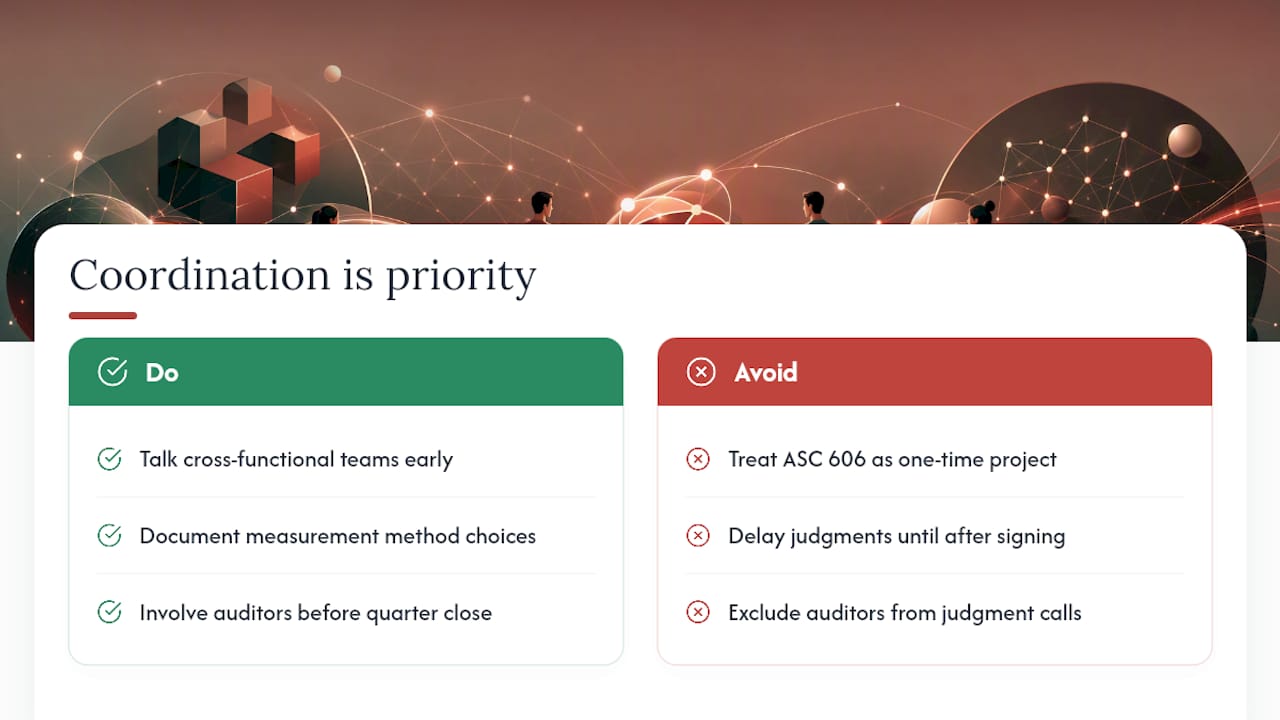
ASC 606 is still, years after adoption, a practice-heavy standard. The technical guidance hasn't changed much, but the judgment burden hasn't gotten lighter either. Companies that treat it as a one-time implementation project rather than an ongoing discipline are the ones that end up restating.
The priority for 2026 is straightforward: get commercial, accounting, and IT teams talking early, before a contract is signed rather than after. Document your measurement method choices as you make them. Bring auditors into judgment calls on variable consideration and licensing before quarter close, not during it.
— Klara
Screen Revenue Recognition Risk Before You Pay for a QoE
If you're evaluating an acquisition target, the ASC 606 judgment areas in this guide (variable consideration, principal vs. agent, contract cutoffs) are exactly where deal risk hides. Add-back automates ingestion and normalization of bank statements, general ledgers, and contract data, then surfaces revenue-quality issues and anomalies in about 60 minutes instead of the six weeks a traditional review takes.
- Private equity investors and lenders get transaction-level evidence on revenue timing and collectibility, not a sampled subset.
- Advisors get a documented trail they can hand to auditors or credit committees without rebuilding it manually.
If you want to see what that looks like before committing to a full quality-of-earnings engagement, screen an acquisition with Add-back first.
Where to Go Deeper on ASC 606
For the authoritative text itself, start with the IFRS 15 revenue recognition standard, which shares the same core five-step architecture as ASC 606. The KPMG revenue recognition handbook and BDO's implementation guidance both offer practical roadmaps with worked examples for the judgment areas covered above.
This article is general information, not a substitute for advice from a qualified financial advisor. Consult a qualified financial professional about your own circumstances before acting on anything here.
Sources
- ASC 606: Measuring performance obligations over time (Deloitte roadmap)
- IFRS 15 / revenue recognition standard (IFRS Foundation)