
60 Minute Accounting Led Screening for Fixed Asset Verification in M&A

Fixed asset verification confirms that a target's fixed asset register, depreciation schedules, and supporting invoices actually back up what's sitting on the balance sheet. The first move is simple: request the fixed asset register, depreciation schedule, and supplier invoices, then map them against the trial balance before anyone signs a letter of intent. Assign this to your accounting due diligence lead, not a generalist, and expect a working exception list within days rather than weeks.
TL;DR:
- Verifying the fixed asset register requires detailed reconciliation of asset IDs, invoices, and depreciation schedules within days of data request.
- Automated tools can quickly ingest full asset populations and flag anomalies, reducing manual effort and uncovering ghost or unsupported assets early.
- Incomplete data requests or overreliance on management schedules often lead to verification delays and undisclosed asset misstatements.
- Quantifying exceptions with supporting evidence influences deal terms, with unresolved or material findings typically prompting price adjustments or indemnities.
- Early fixed asset verification informs valuation and negotiation strategies, preventing costly surprises during post-close integration.
Table of Contents
- What to Request First: The Fixed Asset Evidence Packet
- How to Verify Fixed Assets: A Step-by-Step Reconciliation Process
- Turning Exceptions Into Dollar Figures and Deal Terms
- Where AI Fits in the Verification Workflow
- A Practical Timeline for Deal Teams
- Physical Inspection: Where It Still Matters in Accounting Verification
- Handling Lost, Stolen, or Obsolete Assets on the Register
- How to Document and Present Verification Findings
- Internal Controls Worth Reviewing During Verification
- Common Pitfalls That Derail Fixed Asset Verification
- Why Early Verification Changes Deal Outcomes
- How AddBack Compresses Fixed Asset Screening
- Sources
What to Request First: The Fixed Asset Evidence Packet
Send this request packet on day one, before the data room even opens fully. The faster you get clean asset-level data, the faster you can tell whether the target's plant, property, and equipment line is real or wishful thinking.
- Fixed asset sub-ledger or register with unique asset IDs, cost, placed-in-service date, useful life, accumulated depreciation, and net book value for every recorded item.
- Depreciation schedules and capitalization policy memos, including the dollar threshold above which purchases get capitalized versus expensed.
- Invoices, purchase orders, and vendor contracts tied to each material asset, plus title deeds and lease agreements for real property and equipment under lease.
- Disposal paperwork for anything retired, sold, or written off in the last two to three fiscal years.
- Insurance schedules and maintenance logs, which often reveal assets that exist physically but never made it onto the books, or vice versa.
- Cost segregation studies, if the target has ever commissioned one, since these give you an independent baseline against depreciation categories.
- A trial-balance mapping file linking each fixed asset GL account to its corresponding line in the financial statements.
Ask for everything in CSV or Excel format with a consistent asset ID column running through every file. That single request saves hours of manual matching later, since it lets you join the register to invoices and the general ledger with a lookup formula instead of eyeballing PDFs. Practical checklists built for tax and financial due diligence consistently flag the same failure points: incomplete registers, assets that were never added to the sub-ledger, misclassified asset categories, and depreciation lives that don't match the target's own stated policy. If the target can't produce a clean register on request, treat that gap itself as a finding, not just an inconvenience.
How to Verify Fixed Assets: A Step-by-Step Reconciliation Process
Once the packet lands, work through it in a fixed order. Skipping steps to save time usually means redoing them later when a lender or investment committee asks a question you can't answer.
- Reconcile the sub-ledger to the general ledger and trial balance. Total the fixed asset register, tie it to the GL fixed asset accounts, and confirm both agree with the balance sheet. Any variance over your materiality threshold gets flagged immediately.
- Trace invoices to asset records. Pull a sample of the largest and most recent additions and match each to its invoice, purchase order, and cash disbursement. Confirm vendor names, dates, and amounts line up, and flag any asset with no supporting invoice at all.
- Test depreciation reasonableness. Recalculate accumulated depreciation using the stated method and useful life, and check that placed-in-service dates make sense against invoice dates. A recalculation that doesn't match the books is one of the most common findings in this exercise.
- Assess impairment and obsolescence. Compare capital expenditure and maintenance spending trends over three to five years, and look specifically for assets carried at zero net book value that are still in active use, since these often understate future capex needs.
- Run analytic checks. Fixed-asset turnover, capex-to-revenue ratios, and year-over-year addition and disposal trends will tell you quickly whether the asset base is growing in line with the business or has been neglected.
- Decide where sampling is defensible. Full tracing makes sense for material, recent, or unusual additions. Statistical or judgmental sampling is reasonable for large populations of low-dollar, homogeneous assets, but any related-party purchase or asset acquired near the valuation date deserves full documentary tracing regardless of size.
Pro Tip: Pull the five largest asset additions from the last 12 months first. If those five don't trace cleanly to invoices, the rest of the register almost never does either.
Because financial due diligence typically relies on management information and reconciliations rather than an audit-level trace of every transaction, professional skepticism matters more here than a mechanical checklist. The ICAEW financial due diligence guideline is explicit that FDD is not an audit opinion, which is exactly why corroborating evidence, not just management's word, carries the weight in this process.
Turning Exceptions Into Dollar Figures and Deal Terms
Every finding from the reconciliation step needs to become a number before it means anything to a deal team. A "ghost asset" still on the register but scrapped two years ago overstates net book value by its full remaining carrying value. An asset misclassified as a disposal when it's actually still in service works the other direction, understating the asset base and potentially EBITDA-adjusted capex needs.
- Quantify each exception individually: ghost assets, overstated net book value, misclassified disposals, and unsupported additions all get their own line in an exception log with a dollar impact.
- Set a materiality threshold early, often a percentage of enterprise value or EBITDA, so the deal team knows which findings warrant a purchase price adjustment versus an escrow holdback or a simple disclosure.
- Larger, unresolved exceptions typically translate into price reductions, indemnity provisions, or in some cases a conditional close pending further verification.
These numbers don't stay contained to the fixed asset schedule. Under ASC 805, the acquirer must recognize and measure identifiable assets at acquisition-date fair value, so incomplete or unreliable asset-level data forces valuation specialists into broader allocations that auditors frequently push back on. In stock purchase deals specifically, the buyer often retains the target's historical tax basis while GAAP requires fair-value remeasurement, meaning your team may need to maintain two parallel data sets, tax and post-close GAAP, a complication the stock-versus-asset purchase structure makes easy to underestimate. Note any Form 8594 allocation considerations here too, since the purchase price allocation for tax purposes doesn't always match the GAAP PPA.
Package the output as an exception summary, a reconciled sample workpaper, and a short set of recommended accounting and negotiation actions, not a wall of raw data.
Where AI Fits in the Verification Workflow
Manual fixed asset verification on a mid-size target with a few thousand line items can eat a week of an analyst's time just on invoice tracing. Automated ingestion tools change that math by reading GL exports, bank statements, and fixed asset registers directly, normalizing inconsistent vendor names and date formats, and auto-linking invoices to their corresponding asset entries.
- What automation handles well: full-population ingestion instead of a sample, consistent normalization across messy exports, and anomaly flags on things like duplicate asset IDs or depreciation math that doesn't foot.
- What still needs a human: fair-value judgments for PPA, legal verification of title and lease terms, tax elections, and any assessment requiring professional skepticism about management's representations.
A recommended workflow that's proven effective pairs automated, full-coverage screening with targeted manual follow-up only on flagged exceptions, which improves coverage compared with the sample-based approach traditional QoE reports rely on. This is the model Add-back was built around: AddBack compresses the initial screening phase from roughly six weeks down to about 60 minutes by ingesting and normalizing bank statements, general ledgers, and asset data automatically, then surfacing anomalies for the deal team to investigate rather than asking analysts to sample their way through thousands of rows.
Pro Tip: Run automated screening before you commission a full quality of earnings report. If the fixed asset base throws up major exceptions in the first pass, you'll know whether the deal is worth the QoE spend at all.
A Practical Timeline for Deal Teams
Verification work moves fast when the sequence is right and stalls when it isn't. Here's a workable cadence.
- First 24 to 72 hours: send the evidence request packet, confirm file formats with the target's accounting team, and run an automated ingestion pass if you have the tooling to catch obvious red flags immediately.
- Week one: reconcile the sub-ledger to the GL and trial balance, trace a sample of invoices, and verify the capitalization policy and depreciation calculations.
- Escalate immediately if you find inconsistent placed-in-service dates, large disposals with no paper trail, or missing invoices on material assets.
- Bring in specialists early: an accounting SME for the reconciliation work, a valuation specialist once PPA questions surface, a tax advisor for book-tax basis differences, and legal counsel for title and lease review.
Build your deliverables as you go, an exception log, a quantified impact table, and draft negotiation language, rather than assembling them all at the end.
Physical Inspection: Where It Still Matters in Accounting Verification
Documentary reconciliation is the core of this process, but a limited physical check still adds value on high-dollar or high-risk asset categories, particularly machinery, vehicles, and real property improvements. The goal here isn't a full site-wide tagging exercise. It's spot-confirming that the assets generating the largest depreciation charges and carrying the highest net book values actually exist and match their register descriptions.
Where the target already tags and labels assets, request the tagging methodology and a sample of tag numbers to cross-reference against the register. Consistent barcode or serial-number tagging tied to the asset ID in the register is a strong positive signal. It means whoever built the target's fixed asset system was disciplined about it, and it makes your invoice-to-asset tracing far easier because the identifiers already match.
Where tagging is absent or inconsistent, don't try to build a tagging system yourself during diligence. Instead, note it as an operational finding, flag it for post-close remediation, and lean harder on invoice tracing and depreciation math to compensate. For leased equipment or real property, a lease agreement review often substitutes for physical inspection entirely, since the lease terms establish existence and condition obligations contractually. Partner guidance on equipment sale-leaseback structures is useful here for spotting ASC 842 lease classification risks that a quick document review can miss.
Handling Lost, Stolen, or Obsolete Assets on the Register
Every asset-heavy target has some version of this problem: equipment that was scrapped without a disposal entry, machinery that walked off a job site years ago, or software licenses still depreciating on the books for a system nobody uses anymore. These "ghost assets" inflate the balance sheet without inflating anything real.
Start by cross-referencing the register against maintenance logs and insurance schedules. An asset with no maintenance activity for several years and no insurance coverage listed is a strong candidate for something that no longer exists physically, even though it's still generating a depreciation expense. Assets sitting at or near zero net book value but still tagged as "in service" deserve a second look too, since they may be fully depreciated but genuinely still in use, which is fine, versus fully depreciated and quietly retired without paperwork, which isn't.
Once you identify a likely ghost or obsolete asset, quantify its remaining net book value and add it to the exception log as a straightforward overstatement. There's no ambiguity in the accounting treatment here: if the asset doesn't exist or isn't in service, its carrying value shouldn't be on the balance sheet, and the adjustment flows directly into your quantified findings. For stolen assets specifically, check whether an insurance claim was filed and whether any recovery was recorded, since a mismatch between the claim and the register entry is itself a documentation red flag worth raising with the target's finance team.

How to Document and Present Verification Findings
A verification finding is only useful if the next person who reads it can act on it without calling you to ask what you meant. That means every exception needs three things: what was found, the dollar impact, and the supporting evidence reference.
Structure the output as a standing exception log rather than narrative prose buried in a memo. Each row should reference the specific asset ID, the nature of the discrepancy (missing invoice, depreciation miscalculation, ghost asset, misclassification), the dollar impact, and a pointer to the supporting workpaper or invoice image. This format lets a deal partner or lender's credit committee scan the log in minutes rather than reading a ten-page narrative.
Attach the underlying evidence rather than summarizing it away. If you traced an invoice to an asset, keep the invoice image linked to that log entry. If you recalculated depreciation, keep the recalculation workpaper attached, not just a sentence saying "depreciation appears reasonable." Reviewers, whether that's an investment committee, a lending credit team, or the target's own auditors post-close, will ask for that evidence eventually, and having it organized upfront saves a second round of document requests.
Close the reporting package with a short recommendations section: which findings warrant a price adjustment, which need an indemnity provision, and which are simply disclosure items for the closing memo. Keep this separate from the raw exception log so a reader can find the "so what" without wading through every line item first.
Internal Controls Worth Reviewing During Verification
Fixed asset verification isn't only about confirming what's already on the books. It's also a window into how well the target's accounting function actually operates, which matters enormously for post-close integration planning.
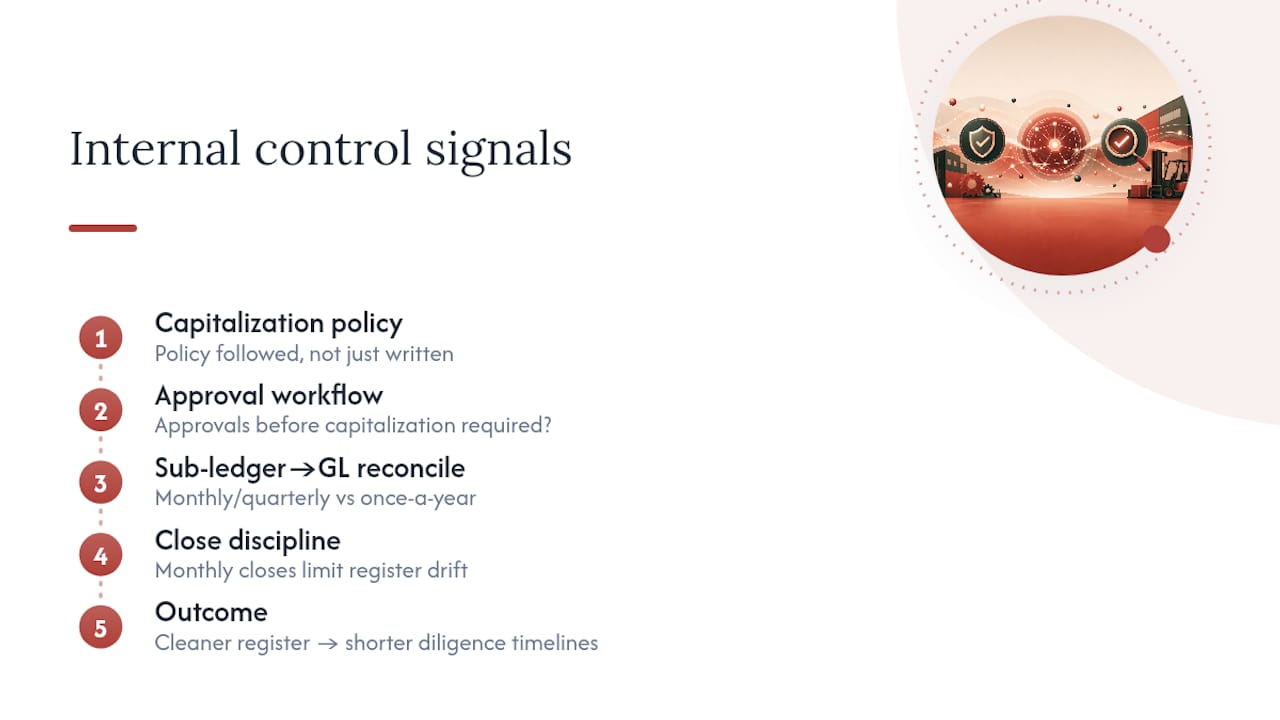
Look for evidence of a formal capitalization policy that's actually followed, not just written down somewhere. A policy that says purchases over $5,000 get capitalized, paired with a register full of $200 items, tells you the policy exists on paper but isn't enforced in practice. Ask whether fixed asset additions require any approval workflow before capitalization, and whether someone reconciles the sub-ledger to the GL on a monthly or quarterly basis, or whether that reconciliation only happens once a year at close.
Weak controls here tend to compound. A target that doesn't reconcile monthly often has a fixed asset register that drifts further from reality every quarter, which is exactly why fixed asset diligence checklists built for financial due diligence put such heavy emphasis on capitalization policy consistency and monthly close discipline as leading indicators of register quality. Consistent monthly closes and disciplined asset-level tracking correlate strongly with cleaner registers and materially shorter diligence timelines, since less time goes into cleanup and more into actual valuation work.
Flag control gaps separately from valuation findings in your report. A control weakness might not carry an immediate dollar impact, but it tells the buyer what kind of post-close finance function they're inheriting, which matters for integration budgeting even when the numbers themselves reconcile cleanly.
Common Pitfalls That Derail Fixed Asset Verification
The single most common failure point isn't a bad finding. It's an incomplete data request that forces three or four follow-up rounds before the team has enough to actually verify anything. Ask for everything in the evidence packet upfront, in a consistent format, rather than trickling requests in as gaps surface.
A second recurring problem is treating management's fixed asset register as ground truth without corroboration. FDD work relies heavily on management information, but that reliance has to be paired with professional skepticism, tracing a meaningful sample back to independent evidence like invoices and title documents rather than accepting the schedule at face value.
Depth of testing also varies more than deal teams expect. Buy-side teams in some markets run detailed trial-balance level reconciliations as standard practice, while sell-side preparation is often far less rigorous, meaning the same target can look very different depending on who prepared the numbers you're reviewing and what standard they applied.
Finally, teams frequently treat fixed asset verification as a standalone checkbox instead of connecting it to valuation and tax outcomes. A finding that seems minor in isolation, like a batch of misclassified disposals, can shift PPA allocations and goodwill calculations meaningfully once a valuation specialist runs it through the fair-value model. Loop in that specialist early rather than handing over a finished exception log and hoping the connections are obvious.
Why Early Verification Changes Deal Outcomes
Fixed asset verification often gets treated as a box to check after the "real" financial due diligence work on revenue and margins is done. That ordering is backwards for asset-heavy targets, manufacturing, logistics, healthcare equipment, where a misstated fixed asset base can distort EBITDA multiples and post-close capex assumptions more than a messy revenue recognition policy ever would.
The value of catching this early isn't just about accuracy. It's about leverage. A ghost asset finding surfaced in week one becomes a negotiating point. The same finding surfaced during post-close integration becomes a dispute, or worse, a write-off nobody budgeted for. Early involvement of specialists who understand both the accounting mechanics and the PPA implications consistently prevents the expensive remediation that shows up six months after close, when nobody wants to reopen the deal terms.
— Klara
How AddBack Compresses Fixed Asset Screening
Add-back gives deal teams full-coverage visibility into a target's fixed asset base without waiting six weeks for a traditional quality of earnings report to get there. The platform ingests and normalizes bank statements, general ledgers, and fixed asset registers automatically, then flags anomalies like unsupported additions, depreciation math that doesn't foot, or ghost assets still sitting on the books, work that would otherwise mean sampling a fraction of the register and hoping the sample generalizes.
That screening fits naturally ahead of the manual deep-dive work described throughout this piece: let AddBack surface the exceptions across the full population first, then send your accounting SME and valuation specialist straight to the items that actually matter instead of starting from a blank slate. If you're evaluating an acquisition and want to see how fast a fixed asset base can be screened before you commit to a full QoE, try a sample AddBack report and see the exception list for yourself.
Sources
For deeper procedural context, the ICAEW financial due diligence guideline covers FDD scope and limitations, Corporate Finance Institute outlines standard asset due diligence checklists, and the ASC 805 business combinations guide explains purchase price allocation mechanics relevant to verification findings.