
Related Party Transactions: Standards, Risks, and Controls

A related-party transaction is any transfer of resources, services, or obligations between a reporting entity and a party connected to it through control, significant influence, or key management, regardless of whether money changes hands. Identifying one requires checking it against IAS 24, ASC 850, and, for SEC registrants, Item 404's $120,000 threshold. From there, assess materiality and confirm what belongs in the disclosure notes. A tool like AddBack can accelerate that identification step across large transaction sets.
TL;DR:
- Transactions involving related parties must be identified using control, influence, or senior management relationships before disclosure, with tools like AddBack easing the process.
- In most frameworks, even non-cash arrangements like rent-free use or management services require disclosure, regardless of the transaction amount or invoicing; SEC Rule 404 demands detailed disclosure for transactions over $120,000.
- A comprehensive related-party disclosure should detail the relationship, transaction nature, amounts, outstanding balances, key terms, and guarantees, with explicit naming for SEC filings when thresholds are crossed.
- Failure to identify or disclose related-party dealings can lead to costly restatements, regulatory probes, and valuation adjustments, especially if arrangements are hidden or improperly documented.
- Maintaining a quarterly, detailed related-party register supported by contemporaneous documentation and independent reviews significantly reduces risks of non-compliance.
Table of Contents
- What counts as a related party under IAS 24, ASC 850, and SEC rules?
- What are the disclosure thresholds under each standard?
- What types of transactions typically require disclosure?
- How do you identify related parties before reviewing transactions?
- What exactly belongs in a related-party disclosure note?
- How do related-party arrangements distort financial statements and deal outcomes?
- What should a related-party transaction policy include?
- How does automated due diligence help detect related-party anomalies?
- What happens when related-party disclosures fail?
- What documentation should you keep for every related-party transaction?
- What regulatory changes are affecting related-party enforcement?
- The pattern behind most related-party failures
- Where to verify related-party rules and filing examples
- Sources
What counts as a related party under IAS 24, ASC 850, and SEC rules?
IAS 24 defines a related-party transaction as a transfer of resources, services, or obligations between a reporting entity and a related party, whether or not a price is charged. That last clause trips up more accountants than any other part of the standard. A parent company letting a subsidiary use office space rent-free is still a related-party transaction. So is a director providing consulting services at no charge. The absence of cash doesn't remove the disclosure obligation.
ASC 850 frames things similarly for US GAAP filers, though it leans harder on the idea that these relationships "could affect" the entity's operating results or financial position, even if no transaction has occurred yet. The SEC takes a related but distinct angle in Regulation S-K: it cares less about accounting mechanics and more about whether a relationship might improperly benefit an insider at shareholders' expense.
The three frameworks converge on one point: related parties include parents, subsidiaries, joint ventures, key management personnel, and their close family members. Non-cash arrangements, like management services performed for free or below-market asset use, fall squarely within scope. Practitioners who screen only for invoiced transactions will miss a meaningful share of what these standards actually require them to catch.
What are the disclosure thresholds under each standard?
Each framework sets its own bar for what must appear in the notes, and the differences matter when you're preparing filings across jurisdictions.
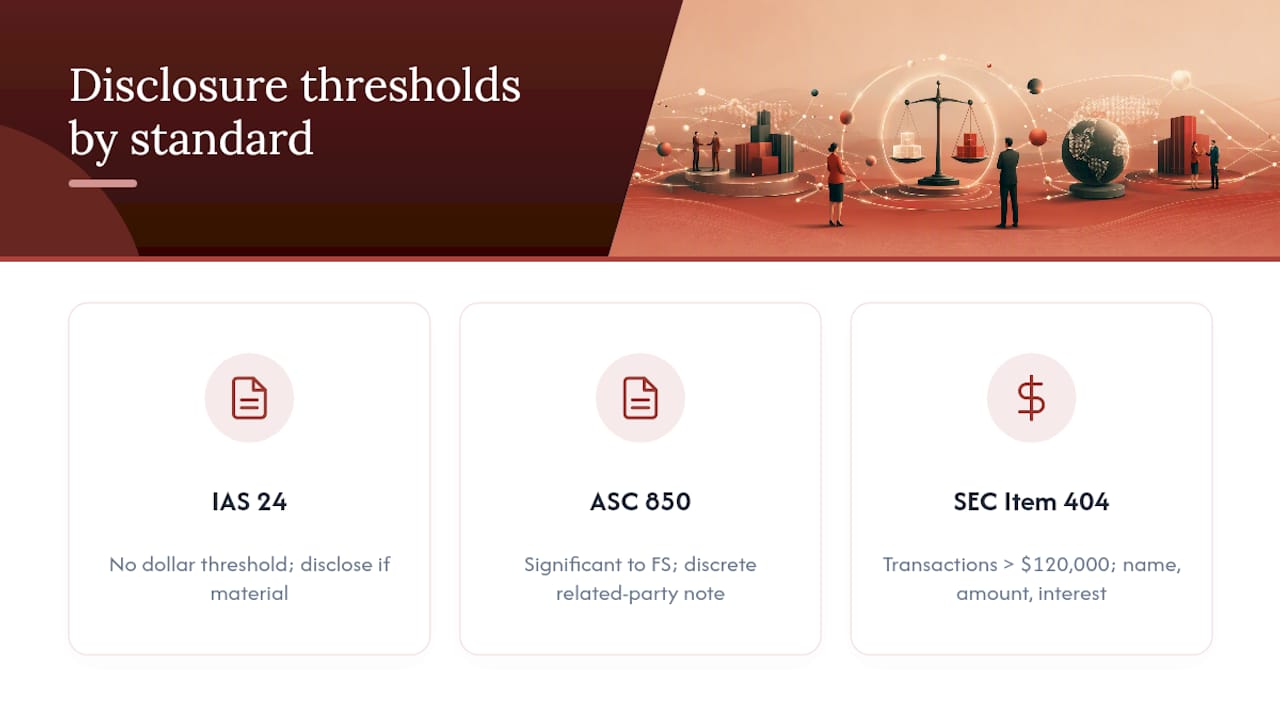
IAS 24 doesn't set a dollar threshold. Its disclosure objective is broader: report enough about relationships, transactions, and outstanding balances that a reader can understand the potential effect on the financial statements. That means even a single significant loan to a director needs disclosure, no matter the amount, if it's material to understanding the entity's position.
ASC 850 works on a similar principle but with more prescriptive presentation guidance for US GAAP preparers. Disclosure triggers whenever transactions with related parties are individually or collectively significant to the financial statements, and companies typically present a discrete related-party note rather than embedding the disclosure into other footnotes.
SEC Item 404 is the one with an actual number attached. For registrants, Item 404 requires disclosure of any transaction since the beginning of the last fiscal year where the company was a participant, the amount involved exceeds $120,000, and a related person has a direct or indirect material interest. The rule requires naming the related person, describing the basis of the relationship, stating the dollar value, and specifying the nature of that person's interest in the deal.
The practical takeaway: a transaction that's immaterial under IAS 24's qualitative test could still trigger a hard disclosure requirement under Item 404 purely because it crosses $120,000. Check both tests, not just one.
What types of transactions typically require disclosure?
Related-party transactions show up in more places than most finance teams expect, and PwC's practitioner guidance lists the categories that recur across nearly every audit:
- Sales and purchases of goods or property between affiliated entities, often priced differently than an arm's-length deal would be.
- Services rendered or received, including management fees, shared back-office functions, or consulting arrangements with insiders.
- Leases, particularly when a company rents property from an owner, executive, or family member.
- Loans and guarantees, including intercompany financing and personal loans to key management.
- Equity arrangements, such as stock issued to insiders outside normal compensation channels.
- Intra-group allocations, where shared costs get split across subsidiaries using internal formulas.
Intra-group transactions between entities that consolidate typically get eliminated on the consolidated financial statements, but they still require disclosure at the parent or subsidiary level where they aren't eliminated. Consolidation removes the balance from the numbers; it doesn't remove the disclosure obligation.
How do you identify related parties before reviewing transactions?
Identification has to come before disclosure, and most audit deficiencies trace back to a related party nobody flagged in the first place. Work through these tests in order:
- Control test. Does one party hold the majority voting power, or the practical ability to direct the other's financial and operating decisions?
- Joint control test. Do two or more parties share control under a contractual arrangement, as in a joint venture?
- Significant influence test. Does a party hold enough ownership or board representation to influence policy decisions without full control, typically starting around 20% ownership?
- Key management personnel (KMP) test. Does the individual have authority and responsibility for planning, directing, or controlling the entity's activities, whether or not they hold a formal title?
- Close family test. Is the counterparty a spouse, child, or dependent of someone who meets one of the tests above?
Watch for red flags in the ledger itself: vendors with no online presence, payment terms wildly different from the entity's standard policy, invoices approved by the same person who benefits from them, or round-number transactions that never quite match a market rate. Aggregation is where a lot of teams stumble. Materiality assessments should combine transactions by related person, not evaluate each invoice in isolation. Ten separate $15,000 payments to the same director's consulting firm add up to $150,000, well past most materiality thresholds, even though each one looks small on its own.
Pro Tip: Build a standing related-party register at the start of every fiscal year, listing every KMP, their close family members, and any entity they control. Screening the general ledger against that list takes minutes instead of days when audit season hits.
What exactly belongs in a related-party disclosure note?
A complete disclosure note needs specific, itemized information, not a vague acknowledgment that "certain transactions with related parties occurred during the period." Regulators and auditors expect to see:
- Nature of the relationship. State whether the counterparty is a parent, subsidiary, KMP, or close family member, and describe the basis for that classification.
- Description of the transaction. What was exchanged: goods, services, a lease, a loan, a guarantee.
- Dollar amounts. The transaction value for the period, not just an ending balance.
- Outstanding balances. Any receivable or payable still open at period end, along with its terms.
- Key terms. Interest rates on loans, lease duration, payment schedules, and whether terms match market rates.
- Guarantees and commitments. Any obligation the entity has taken on, or been given, involving a related party, even if unfunded as of the reporting date.
Under IAS 24, you generally name the related party or at least the category of relationship (parent, subsidiary, associate, KMP) rather than leaving it generic. ASC 850 disclosure follows the same logic. SEC Item 404 goes further and requires actually naming the related person, not just categorizing the relationship, once the $120,000 threshold is crossed.
Aggregation is acceptable when transactions are similar in nature and no individual instance is separately material. What's not acceptable is aggregating dissimilar transactions to obscure the total exposure. A note that lumps a rent-free office arrangement in with an unsecured $2 million loan under one combined figure tells the reader almost nothing useful.
Wording matters more than most preparers realize. Auditors specifically look for language confirming whether terms were negotiated at arm's length or state plainly that they were not, since claiming arm's-length terms without support is a documented audit weakness. If a transaction wasn't negotiated at market rates, say so directly. Vague hedging invites scrutiny, not less of it.
How do related-party arrangements distort financial statements and deal outcomes?
Related-party arrangements can inflate revenue through sales to affiliates that wouldn't happen at market pricing, understate costs through below-market rent or free management services, or hide leverage through guarantees that never show up on the balance sheet. Any of these can make a company look more profitable or less risky than it actually is.
Auditors respond by testing these arrangements harder than ordinary transactions. Expect requests for board minutes approving the deal, third-party market comparables, independent valuations, and correspondence showing the terms were actually negotiated rather than assumed. Auditors specifically look past the contract's legal form to the transaction's economic substance before accepting any arm's-length claim.
In M&A, related-party arrangements frequently cloud an acquirer's read on recurring performance, which is why deal teams often push to unwind or replace them before close. That usually means modeling the cost of replacing a below-market service with a market-rate vendor and adjusting EBITDA accordingly, using replacement cost estimates or third-party quotes as evidence for the adjustment rather than management's own assertion.

What should a related-party transaction policy include?
A working policy needs a pre-approval step before the transaction closes, an independent reviewer who isn't the person benefiting from the deal, and a ratification process for anything discovered after the fact. Public filings, including sample related-party transaction policies, show this workflow in practice, typically routed through an audit committee rather than management alone.
- Set a dollar threshold that automatically triggers committee review, not just executive sign-off.
- Require documented evidence, such as market comparables or competing quotes, before anyone claims a transaction is at arm's length.
- Log every related-party transaction in a central register, updated quarterly, not just at year-end.
- Report the full register to the audit committee at least annually, with variances flagged.
Pro Tip: Ask your policy to require re-approval of standing arrangements (like a lease with a director) every 12 months. Deals approved once and never revisited are where stale terms and unnoticed drift tend to hide.
How does automated due diligence help detect related-party anomalies?
Manually tracing related-party flows across years of bank statements and general ledger entries is slow, and it's easy to miss a pattern spread across dozens of small transactions. AI-driven ingestion of ledgers, bank statements, and contracts can surface recurring counterparties, flag pricing that deviates from market norms, and group scattered payments by the same related person automatically.
AddBack's approach produces normalized flow tables, aggregated exposure figures by counterparty, and cash-proofed transaction histories that highlight anomalies a manual sample might never catch. For a deal team screening an acquisition target, that turns a multi-week related-party sweep into an evidence set ready for the audit committee or the M&A working group in a fraction of the time, with a documented trail auditors can actually test against.
What happens when related-party disclosures fail?
Non-compliance rarely stays contained to a footnote. When a related-party arrangement surfaces after the fact, rather than in a filed disclosure, restatements, delayed closings, and regulatory inquiries tend to follow. A common pattern: a founder or executive routes company purchases through a personal entity at inflated prices, the arrangement never appears in the notes, and it only comes to light during acquisition due diligence or a change in auditor.
The financial damage compounds quickly. Investors who priced a deal off reported EBITDA discover that a chunk of "cost of goods sold" was actually a related-party markup, and the valuation gets renegotiated, or the deal collapses entirely. Lenders who extended credit based on stated collateral values find undisclosed guarantees to an affiliate sitting behind the assets they thought were unencumbered.
Boards face a different kind of exposure: personal liability questions when a related-party deal benefited a director and nobody documented independent review. Audit committees that approve transactions without requiring market comparables leave themselves with no defense if regulators later ask why the terms weren't scrutinized.
The pattern across these situations isn't usually outright fraud. It's more often a disclosure gap: a transaction that technically should have been flagged under IAS 24, ASC 850, or Item 404, but wasn't, because nobody ran it through an identification checklist before the filing went out. The fix costs a fraction of the cleanup. A quarterly related-party register review takes an afternoon. Untangling an undisclosed arrangement during a live deal negotiation can cost months and materially move the purchase price.
What documentation should you keep for every related-party transaction?
Every related-party transaction needs a paper trail that stands up independently of management's word. At minimum, keep the signed agreement or contract, board or committee approval minutes showing the terms were reviewed before the deal closed, and evidence supporting any arm's-length claim, such as competing vendor quotes or an independent valuation.
Store this documentation centrally rather than scattered across department files. When an auditor or a due diligence team asks for support on a related-party lease, the ability to produce the approval minute, the comparable market rent survey, and the payment history within minutes rather than weeks says a lot about how seriously the control environment is actually run.
Timing matters as much as content. Documentation created after the fact, once a transaction is already under scrutiny, carries far less weight than a contemporaneous record. If a related-party consulting arrangement gets approved in March, the market comparable supporting that rate should be dated around March too, not backfilled the following year when an auditor asks for it.
For ongoing arrangements, refresh the supporting evidence periodically rather than filing it once and forgetting it. A lease approved in 2022 at a rate that matched the market then may not reflect current terms if rents have shifted. Keep a renewal or re-approval date on every standing related-party contract, and treat that date as a hard deadline for refreshing the comparables, not a formality.
What regulatory changes are affecting related-party enforcement?
Regulators have been sharpening their focus on related-party arrangements that obscure a company's true financial position, particularly around special purpose vehicles and complex ownership structures that make it harder to spot a control relationship at a glance. Enforcement attention has also grown around companies that disclose related-party terms in vague, boilerplate language rather than the itemized detail Item 404 and ASC 850 actually call for.
The direction of travel across both IFRS and US GAAP frameworks favors more granular disclosure, not less. Standard-setters continue to reinforce that materiality assessments must weigh qualitative factors, not just dollar thresholds, meaning a small transaction involving a controlling shareholder can draw as much scrutiny as a large one involving a minor affiliate.
For practitioners, the practical implication is straightforward: treat every related-party disclosure as if a regulator will read it in isolation, without the context of internal knowledge about the relationship. If the note wouldn't make sense to an outside reader unfamiliar with the company's ownership structure, it likely doesn't meet the actual disclosure objective those standards are built around, regardless of jurisdiction.
The pattern behind most related-party failures
The breakdowns I see most often aren't complicated fraud schemes. They're a founder's consulting invoice nobody classified correctly, or a related-party loan that got booked as a regular receivable because nobody asked who was on the other side of it. The fix is almost always the same: a standing related-party register, checked against the ledger every quarter, not just at audit time.
What tends to get missed is how much faster this process moves with the right tooling. Automated ingestion of bank and ledger data catches pricing patterns and recurring counterparties that a manual sample review, by design, is statistically likely to skip entirely.
Before your next audit committee meeting, bring three things: the current related-party register, evidence supporting every arm's-length claim on it, and a list of any standing arrangement that hasn't been re-approved in the past 12 months. That short checklist catches most of what goes wrong.
— Klara
Where to verify related-party rules and filing examples
For direct guidance rather than secondhand summaries, go to the standards themselves:
- IAS 24 — Related Party Disclosures, the IFRS Foundation's full standard text.
- A filed related-party transactions policy (EX-14), showing real approval workflow language.
Rules vary by jurisdiction and filer status, so confirm current requirements with local regulatory guidance or counsel before finalizing any disclosure.
If you're screening a target company's books for undisclosed related-party exposure before a deal, AddBack's financial due diligence platform ingests bank statements, ledgers, and contracts to surface these relationships in a fraction of the time a manual review takes. Explore how AddBack compares to a traditional quality of earnings engagement for teams evaluating faster, more thorough screening before committing to a full diligence spend.
Sources
- 26.5 Common related party transactions (PwC Viewpoint)
- Related-Party Transactions Policy (SEC filing EX-14)