
M&A Deal Teams: Turn Supplier Concentration Risk Into Auditable Screens

Supplier concentration risk is material whenever a single vendor or category exceeds roughly 20% of cost of goods sold or a comparable share of revenue enablement, and buyers respond with predictable moves. Expect multiple compression, larger escrows, or pre-close consent conditions once concentration crosses the 30% line, and expect deals to stall or restructure above half of the cost of goods sold unless the seller has already fixed the underlying contracts.
TL;DR:
- Supplier concentration risks become material once a single vendor exceeds 10-20% of procurement, with thresholds shifting based on industry and sourcing complexity.
- Early mitigation steps include contract audits, establishing backup suppliers, and volume shifts, ideally begun 12 to 24 months before a deal.
- Concentration issues are priced into deals through multiple compression, escrow increases, and pre-close conditions rather than deal abandonment.
- Contract clauses like change-of-control, termination-for-convenience, and volume-rebate provisions often carry high post-close risks, especially above 25% concentration.
- Automated AI screening tools can identify concentration risks within hours, enabling faster and more reliable decision-making during due diligence.
Table of Contents
- What Is Supplier Concentration Risk in M&A Diligence?
- How to Measure Supplier Concentration for Diligence
- How Supplier Concentration Changes Valuation and Deal Structure
- Contract Red Flags That Signal Closing Risk
- Mitigation Playbook: What Sellers Should Fix and When
- How Buyers Model Concentration Into Financial Schedules
- How AI-Enabled Pre-Deal Screening Speeds Concentration Discovery
- Monitoring Supplier Risk After the Deal Closes
- Regulatory and Compliance Considerations Tied to Supplier Concentration
- Geopolitical Risk and Its Effect on Supplier Concentration
- Building Supplier Concentration Into Enterprise Risk Management
- A Practitioner's View on Triaging Supplier Concentration
- How Add-back Turns Supplier Concentration Into a Fast, Defensible Screen
- Sources
What Is Supplier Concentration Risk in M&A Diligence?
Supplier concentration risk describes how dependent a target's revenue, margin, and working capital are on a small number of vendors. When one supplier controls a critical input, its price hike, capacity cut, or exit can ripple straight into gross margin and cash conversion within a single quarter. That's the mechanism buyers are actually pricing when they ask for vendor spend breakdowns on day one of diligence.
The financial impact shows up in three places at once:
- Revenue at risk: if a key input supplier fails, production or delivery halts, and booked revenue slips or disappears.
- Margin pressure: a supplier with leverage renegotiates price upward the moment they sense a buyer needs continuity.
- Working capital swings: emergency sourcing at short notice usually means worse payment terms and higher safety stock, which eats cash.
Thresholds shift by industry. A niche manufacturer sourcing a proprietary component from one fabricator carries far more risk at 25% concentration than a distributor buying commodity freight at the same share, because switching cost and lead time differ enormously. Buyers typically start asking pointed questions once a single supplier hits 10-20% of procurement or revenue, and that threshold isn't arbitrary. Academic research backs the strategic stakes: a one-standard-deviation increase in supplier concentration raises the likelihood of a vertical acquisition by about 11% and deal value by about 44%, which tells you concentration doesn't just create downside risk, it actively shapes deal-making behavior on both sides of the table.
How to Measure Supplier Concentration for Diligence
Measurement has to survive a data room audit, not just impress a partner in a meeting. Run this sequence on every deal:
- Normalize the vendor master. Pull raw AP and procurement records, then standardize vendor names, currencies, and fiscal periods so duplicates don't distort the picture.
- Roll up by parent entity. A target might show five separate "top 20" vendors that are actually subsidiaries of one holding company. Rolling up by parent company or tax ID before calculating shares is the single step most junior analysts skip, and it's the one that most often changes the headline number.
- Calculate top-N shares and HHI. Compute top-1, top-3, and top-5 spend concentration, then run a Herfindahl-Hirschman Index across the full vendor base to catch diffuse-but-still-risky patterns that top-N alone misses.
- Map category criticality. Cross-reference dollar concentration against how easily each category could be re-sourced. A low-dollar, single-source component can outrank a high-dollar commodity purchase in actual risk.
- Run quarter-over-quarter growth checks. Rapid vendor growth quarter over quarter is often the earliest signal of a dependency forming before it shows up in a trailing-twelve-month view.
Escalate findings on a simple cadence: flag anything above 10% for a closer look, treat 20% as a standing diligence item, bring in legal and commercial leads at 30%, and treat 50%+ as a deal-structure conversation, not a footnote.
Pro Tip: Ask for 8 consecutive quarters of AP data by vendor, not just the trailing twelve months. Concentration that looks stable on an annual view often hides a supplier that doubled its share in the last two quarters.
How Supplier Concentration Changes Valuation and Deal Structure
Buyers rarely walk away from a concentrated supplier base outright. They reprice it, and the repricing tends to follow a pattern once concentration is confirmed and unmitigated:
- Multiple compression on the affected earnings stream, applied selectively rather than across the whole valuation.
- Escrow sizing increased specifically to cover the cost of a forced resourcing event within the first 12 to 24 months post-close.
- Pre-close conditions requiring the seller to secure a signed supply agreement or consent-to-assign before funds move.
- Consent requirements written into the purchase agreement obligating the buyer to notify or renegotiate with the vendor post-close.
The gap between discovering concentration early versus late is enormous and mostly about who controls the negotiation. A seller who runs contract remediation before going to market can spend as little as $5,000 to $15,000 in legal fees to formalize agreements that otherwise cost hundreds of thousands in lost deal value once a buyer finds the gap during exclusivity. Once a buyer has leverage in an exclusivity period, the same fix costs the seller far more in negotiating power than it would have cost in legal fees six months earlier.
Evidence of mitigation, documented supply agreements, a second qualified vendor, a demonstrated volume shift, tends to compress or eliminate the pricing adjustment entirely. Buyers aren't pricing the existence of concentration; they're pricing the absence of a plan.
Contract Red Flags That Signal Closing Risk
A contract audit is not optional in any deal where top-5 vendor concentration clears 25%. Certain clauses create outsized post-close risk regardless of the dollar amount involved:
- Change-of-control provisions that let a supplier terminate or renegotiate the moment ownership changes. These clauses are consistently flagged as the highest-risk contract element, because they surface exactly when a buyer has the least room to walk away.
- Assignment restrictions that block the agreement from transferring to a new entity without separate written consent.
- Termination-for-convenience clauses with short notice windows, sometimes as little as 30 days, that give a supplier an easy exit if better terms appear elsewhere.
- Price-renegotiation rights triggered by ownership change, volume threshold, or contract anniversary.
- Exclusivity or volume-rebate structures that quietly increase switching costs by tying pricing to purchase commitments the buyer may not want to keep.
Vendor financial stress compounds all of the above. Late shipments, factoring arrangements, or a sudden shift in payment terms requested by the supplier are early warning signs worth a direct conversation before the letter of intent is signed.
Pro Tip: Request the last three amendments to each top-5 vendor contract, not just the current version. Amendment history often reveals a supplier that has already renegotiated pricing once and is likely to do it again.
Mitigation Playbook: What Sellers Should Fix and When
Sellers who start remediation 12 to 24 months before going to market consistently land better outcomes than those who scramble during exclusivity. A phased program of contract cleanup, alternate supplier qualification, and small documented volume migrations of 10-20% produces measurably better deal terms than reactive fixes made under buyer pressure.
- Contract audit (months 1-2): inventory every agreement above a defined spend threshold and flag change-of-control and termination clauses.
- Consent negotiation (months 2-4): approach key vendors to formalize verbal arrangements and remove assignment restrictions before a buyer is in the room.
- Alternate supplier qualification (months 3-9): identify and test at least one backup source per critical category, even at low initial volume.
- Gradual volume shifts (months 9-18): move 10-20% of spend to the qualified alternate to create a documented track record, not just a paper option.
- Data-room packaging (ongoing): build a supplier risk matrix tying each concentrated vendor to the specific revenue, margin, and working capital lines it touches.
| Remediation step | Typical timeline | Typical cost range |
|---|---|---|
| Contract audit and cleanup | 4-8 weeks | $5,000-$15,000 in legal fees |
| Alternate supplier qualification | 3-9 months | Internal staff time, minimal direct cost |
| Volume migration and track record | 3 to 12 months | Modest margin cost during transition |
The math favors starting early. A contract audit that costs a few thousand dollars in legal fees routinely preserves deal value in the hundreds of thousands once you account for the multiple compression a buyer would otherwise apply.
How Buyers Model Concentration Into Financial Schedules
Sophisticated buyers don't treat concentration as a narrative risk footnote, they translate it into numbers that flow through the model. The standard approach starts with a scenario: what happens if the top supplier fails, and how long does it take to qualify a replacement? Tying that scenario directly to revenue, gross margin, inventory, and backlog schedules turns a qualitative worry into a quantified adjustment.
A workable process looks like this:
- Set a time-to-replace assumption per critical category, typically 3 to 12 months depending on complexity.
- Apply a margin haircut during the transition window to reflect emergency sourcing costs.
- Adjust working capital assumptions upward for safety stock or deposit requirements tied to a new vendor relationship.
- Score each vendor relationship on a simple matrix combining dollar concentration, switching difficulty, and contract protection, then convert the composite score into a specific escrow or purchase-price adjustment.
This is where a clean, auditable vendor-concentration exhibit earns its keep in a data room. A short slide showing top-N shares, HHI, and contract status tends to move a negotiation faster than pages of narrative explanation, because it gives the buyer's model something concrete to plug in rather than something to argue about.
How AI-Enabled Pre-Deal Screening Speeds Concentration Discovery
Manual vendor analysis eats weeks of an analyst's time pulling AP ledgers, reconciling vendor names, and building the top-N tables by hand. Automated ingestion changes that math. Add-back processes bank statements, general ledgers, and vendor records to produce vendor-share rollups and flag contract risk indicators in about 60 minutes rather than the several weeks a traditional review takes.
- Vendor rollups arrive normalized by parent entity automatically, closing the exact gap that causes analysts to undercount concentration.
- Contract-adjacent flags surface alongside the financial data, so a change-of-control risk shows up next to the spend number that makes it matter.
- Auditable spreadsheets replace static PDF summaries, letting a deal team defend the numbers directly in negotiation.
Automation has real limits. Supplier interviews, physical test orders, and in-person qualification of an alternate vendor still require a human in the loop; software surfaces where to look, not the vendor's actual willingness to keep supplying after close.
Monitoring Supplier Risk After the Deal Closes
Concentration doesn't freeze on closing day.
Build monitoring into the first 100-day plan rather than treating it as a diligence artifact to file away. A quarterly refresh of the same top-N and HHI metrics used in diligence keeps the risk visible instead of buried in a post-close binder nobody reopens. Assign ownership explicitly: procurement or finance should own the vendor-concentration dashboard, and it should route to the same person who tracks working capital covenants, since the two are connected.

Three practices tend to separate portfolio companies that catch drift early from those that don't. First, re-run the quarter-over-quarter growth check used during diligence on a recurring basis, since a supplier's share creeping upward is often the first visible symptom of a category consolidating around fewer vendors. Second, keep the alternate-supplier relationships qualified during diligence actually active with occasional purchase orders, not just documented on paper, because a backup vendor that goes cold for two years is barely a backup at all. Third, revisit contract terms at each renewal cycle rather than letting evergreen clauses auto-renew unreviewed, since a favorable term negotiated pre-close can quietly expire.
For lenders holding covenant-based facilities, concentration drift matters even more directly. A borrower whose top supplier share climbs materially between covenant tests can trip early-warning triggers well before a formal default, giving the lender time to engage rather than react.
Regulatory and Compliance Considerations Tied to Supplier Concentration
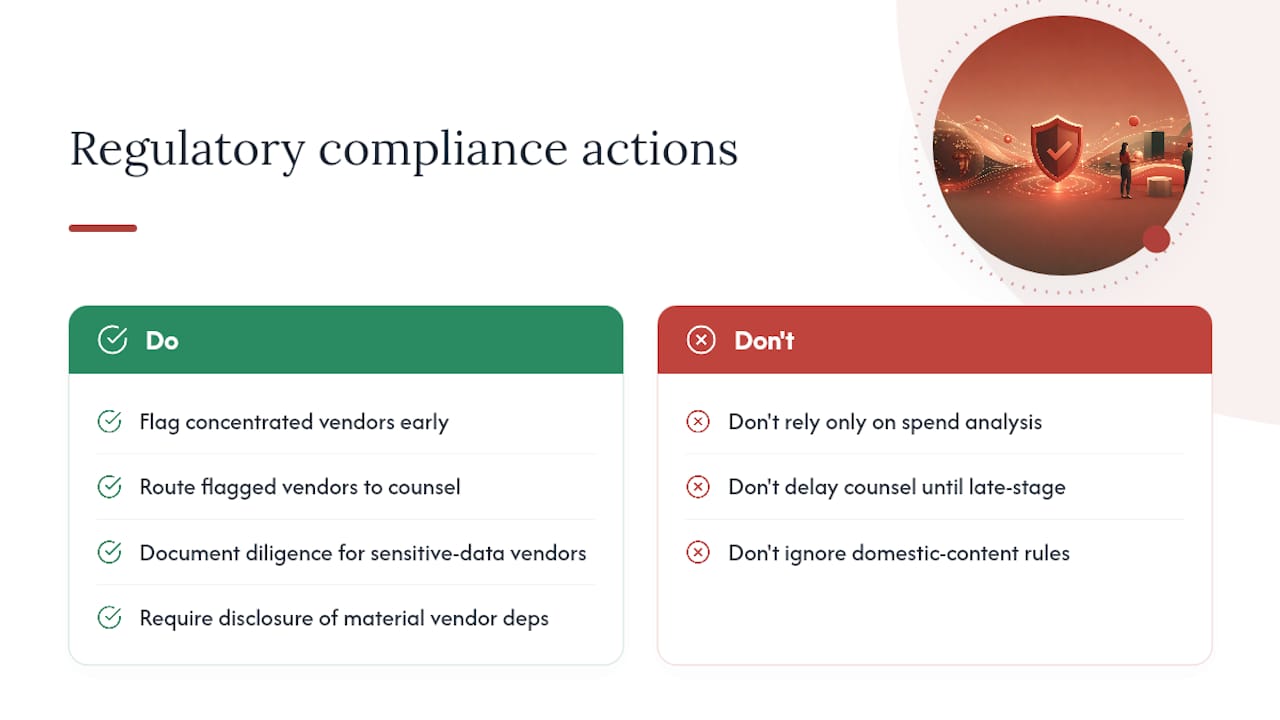
Supplier concentration intersects with compliance obligations in ways that vary sharply by industry, so a generic checklist won't cover every deal. Regulated sectors carry the heaviest overlay. Financial services and healthcare targets often face vendor-risk-management rules that require documented due diligence on any supplier handling sensitive data or a critical operational function, meaning a concentrated IT or processing vendor isn't just a financial exposure, it's an examination item.
Public and near-public companies face disclosure expectations around material vendor dependencies, and a buyer acquiring a business that supplies into a regulated industry inherits whatever disclosure obligations attach to that customer relationship. Government contractors carry a related wrinkle: supply chain sourcing restrictions and domestic-content requirements can make a single foreign supplier a compliance issue independent of price or availability.
Anti-corruption and sanctions exposure deserves a specific look when a concentrated supplier operates across borders. A vendor relationship that clears financial diligence cleanly can still carry sanctions-list or beneficial-ownership red flags that a pure spend analysis won't surface, which is why legal counsel needs the vendor-concentration list early rather than as an afterthought at the end of diligence.
None of this replaces qualified legal review specific to the target's industry and jurisdiction. The practical takeaway for a deal team is narrower: flag any concentrated vendor operating in a regulated data category, a sanctioned or high-risk jurisdiction, or a government-contracting supply chain, and route it to counsel before it becomes a closing condition nobody budgeted time for.
Geopolitical Risk and Its Effect on Supplier Concentration
Geography compounds concentration risk in ways a pure financial model tends to understate. A supplier that looks diversified on paper, three separate legal entities, three separate contracts, can still represent a single point of failure if all three source from one region exposed to the same trade restriction, port disruption, or currency shock.
Trade policy shifts are the clearest example. Currency volatility adds a quieter version of the same risk: a supplier priced in a volatile local currency can force sudden cost increases even when the underlying relationship stays contractually intact.
Deal teams evaluating cross-border supply chains should map concentration by both vendor and country of origin, not vendor alone. Two suppliers in the same coastal region carry correlated shipping and customs risk even if they're commercially unrelated. The same logic applies to single-port or single-corridor logistics dependencies that don't show up in a vendor-name-based concentration table at all.
The mitigation logic mirrors the vendor-level playbook: qualify at least one alternate supplier outside the primary sourcing region for any category above a meaningful concentration threshold, and treat geographic diversification as a distinct line item from vendor diversification in the data room, since buyers increasingly ask about both separately.
Building Supplier Concentration Into Enterprise Risk Management
Treating supplier concentration as a one-time diligence exercise wastes the work that went into measuring it. The metrics built for a deal, top-N shares, HHI, category criticality mapping, belong inside the acquired company's ongoing enterprise risk management framework, not archived in a closing binder.
Integration means assigning supplier concentration a place on the same risk register that tracks credit risk, operational risk, and compliance risk, with a named owner and a review cadence rather than an ad hoc check when something breaks.
The board-reporting layer matters as much as the internal tracking. A quarterly risk dashboard that includes top-3 vendor concentration alongside working capital and covenant metrics gives a board or lender the same visibility a buyer demanded during diligence, applied continuously instead of once. For a private equity portfolio company, this connects directly to the value-creation plan: a fund tracking concentration across its portfolio companies can spot a systemic supplier dependency, say, multiple portfolio companies relying on the same single-source component, before it becomes a coordinated crisis.
The discipline that wins deals shouldn't stop at the closing table. The same rigor that got a supplier-concentration exhibit into a data room is what keeps the next buyer, or the next credit review, from finding a surprise.
A Practitioner's View on Triaging Supplier Concentration
Don't wait for the full vendor analysis to finish before looping in legal and commercial leads. Sequence it as contract audit first, since that's fastest and cheapest, then alternate-supplier qualification, then let finance quantify the adjustment once the first two are done.
— Klara
How Add-back Turns Supplier Concentration Into a Fast, Defensible Screen
Add-back is the fastest way to know whether a target's supplier base will survive buyer scrutiny before you commit real diligence dollars. Instead of waiting weeks for an analyst to hand-build vendor rollups from AP exports, Add-back ingests bank statements, general ledgers, and vendor records directly and returns normalized concentration metrics, parent-company rollups, and contract-risk flags in about 60 minutes.
That output includes the exact building blocks this article walks through: top-N vendor shares, HHI calculations, and flagged clauses worth a legal review, all in an auditable format you can drop straight into a data room or an investment committee memo. It won't replace a supplier interview or a physical test order, but it will tell you in an hour whether a target's vendor base warrants that deeper follow-up at all, which is often the difference between screening out a bad deal early and burning a full diligence budget to find the same answer six weeks later. Run a pre-deal screen on your next target and see the vendor-concentration picture before you sign an engagement letter.
Sources
The thresholds, remediation costs, and measurement steps in this guide draw on practitioner research from Glacier Lake Partners on vendor concentration risk and its companion piece on supply chain diligence for single-source vendors, along with Stampli's finance-team guidance on measuring vendor concentration and ArizonaBizSales' buyer-side breakdown of concentration thresholds. The valuation and strategic-M&A findings reference peer-reviewed research on supplier concentration and corporate acquisitions.
For readers evaluating supply-chain operational strategy alongside financial diligence, The 3PL Cowboy offers an operator's perspective on supplier replacement and logistics risk. To see how automated screening applies these concepts in practice, review Add-back's overview of AI in financial due diligence.
- Vendor concentration risk: the supply-side version of the problem buyers always find | Glacier Lake Partners
- What is vendor concentration risk, and when should a finance team worry? - Stampli
- Supplier concentration and corporate acquisitions: a risk-mitigation perspective (2026)